

Key takeaways
- Structure = Citation – A well-structured page is more likely to be cited than a dense block of text.
- Schema is the shortcut – Implementing the correct JSON-LD types like FAQPage, HowTo, and Article helps AI understand content blocks.
- Quality still matters – Combine solid E‑E‑A‑T signals (author info, up‑to‑date data, citations) with the technical structure above to earn AI‑driven visibility.
Your content might be excellent, but if AI engines can't parse it cleanly, they'll cite someone else's answer instead. The shift from ranking pages to extracting answers changes what "optimised" actually means.
This guide covers the structural elements that make content citable—heading hierarchy, schema markup, site architecture, and the quality signals that tie everything together.
Why content structure matters for AI search visibility
AI search engines extract and cite content based on how clearly it's organised—not just what it says.
To get cited in AI search results, focus on clarity, structure, and authority. That means concise language, clear headings that mirror user questions, short paragraphs, Q&A formats, and schema markup that helps AI understand your content's context.
Here's the key difference from traditional search. Google and Bing used to index your page and rank it as a link. AI engines do something different—they parse your content, pull out specific answers, and present those answers directly to users. Your page might never get clicked, but your words appear in the response.
A well-structured page gets quoted. A wall of text gets skipped.
What makes content stand out in AI search results
Four factors determine whether AI engines pull from your content:
- Clear answers: Direct responses to specific questions, placed in the first sentences of each section
- Logical hierarchy: Headings that signal how topics relate to each other
- Structured data: Schema markup that labels content for machines
- Freshness and accuracy: Up-to-date information with visible publication dates
You'll notice overlap with traditional SEO here. That's intentional. The difference is that AI engines weight structure and clarity more heavily because they're extracting snippets rather than ranking whole pages.
How to structure page content for AI search engines
Titles, meta descriptions, and H1 tags
Your title tag, meta description, and H1 work together to signal topic relevance before AI even reads your body content.
The title tag tells the engine what question you're answering. The meta description summarises that answer. The H1 confirms the topic matches what the title promised.
When all three align, AI engines trust that the page delivers what it claims. When they conflict—say, a title about "pricing" but an H1 about "features"—the engine moves on to a clearer source.
Heading hierarchy with H2s and H3s
Proper nesting helps AI understand how your content connects. H2s introduce main subtopics. H3s support those subtopics with specific points or examples.
Think of headings as an outline. Each level adds detail to the one above it. If you jump from H1 directly to H3, the engine can't tell how ideas relate. That confusion often means your content gets passed over.
Q&A and FAQ formats
Question-based headings work particularly well because they match how users query AI engines.
Someone asking ChatGPT "How do I structure content for AI?" will likely see answers pulled from pages with that exact question as a heading. The format is straightforward: question as heading, direct answer in the first sentence, supporting detail after.
Lists and tables for scannable answers
AI engines often pull lists verbatim into their responses. Knowing when to use each format matters.
[[table]]
Paragraphs work better for nuanced explanations. Lists work better for discrete items. Tables work better when readers compare options side by side.
Lead with the answer using TL;DRs
TL;DR stands for "too long; didn't read"—a summary that gives readers the bottom line upfront.
Traditional blog posts build toward a conclusion. AI-friendly content flips that structure entirely. Put the answer first, then add context. The engine scanning your page finds what it's looking for immediately, which increases the chance of citation.
How schema markup helps AI understand your content
Schema markup is code that labels content types for search engines. It acts like metadata telling AI "this is a FAQ" or "this is a how-to guide" rather than leaving the engine to guess from context.
FAQPage and HowTo schema
Two schema types are important for AI search.
FAQPage marks question-answer pairs so engines can interpret them and may then show them as rich results.
HowTo marks step-by-step instructions with properties for defined steps, tools, and time estimates such as prepTime and totalTime.
Using structured data (including FAQ and HowTo) can help search and answer engines better understand your content and may improve your chances of being cited in AI Overviews.
Article and author schema
Article schema signals content type, publication date, and update date.
Author schema establishes who wrote the piece and their credentials.
Together, they build E-E-A-T signals—Experience, Expertise, Authoritativeness, Trustworthiness—that AI engines use to evaluate source quality.
Matching structured data to visible content
Here's where sites often stumble.
Schema that doesn't match what users actually see on the page creates problems. Misused or ineligible FAQ schema may make your page ineligible for FAQ rich results, according to Google Search documentation.
How can you organise site architecture for AI search strategy?
Page-level structure matters, but site-wide organisation affects how AI understands your topical authority. Try the following.
Topic clusters and content siloing
A topic cluster groups a pillar page with supporting content, all linked together. For example, a pillar page on "AI search optimisation" might link to supporting pages on schema markup, heading structure, and content freshness.
Siloing groups related content to signal depth of expertise. A flat site with unrelated pages scattered everywhere looks less authoritative than a clustered architecture where related content reinforces each topic.
Internal linking for topical context
Internal links help AI understand how your content connects. Link from supporting pages back to pillar content using descriptive anchor text—"learn more about schema markup" rather than "click here."
Descriptive links create pathways that show AI engines the relationships between your pages.
Ensuring crawl-ability and access for AI bots
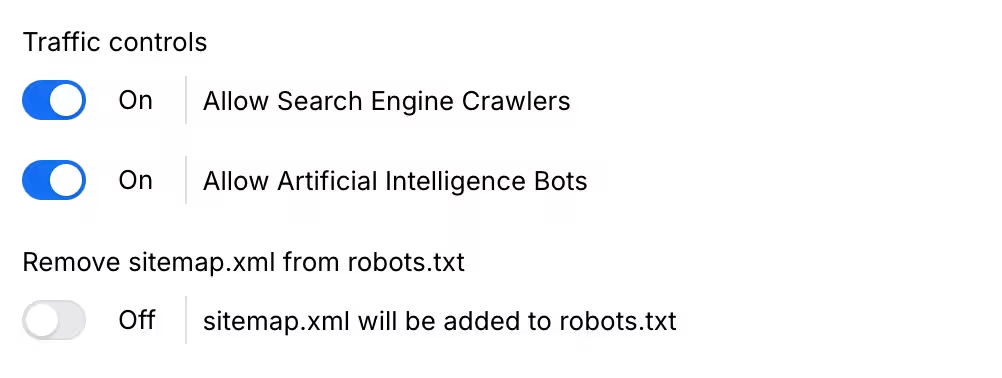
Some sites accidentally block AI crawlers through robots.txt settings or security plugins. Common AI bots to allow access include:
- Googlebot
- Bingbot
- ChatGPT-User
- PerplexityBot
If AI bots can't access your content, they can't cite it—regardless of how well it's structured.
You can control this in your Webflow site by going to the SEO tab of Site Settings.
Why content quality and expertise still matter for AI
Structure without substance won't rank.
AI engines evaluate E-E-A-T alongside structure. Clear organisation makes quality content easier to cite, but thin content with perfect structure still fails.
Quality signals include author credentials, cited sources, and unique insights that readers can't find elsewhere. A well-structured page full of generic advice loses to a slightly messier page with genuine expertise.
AI content optimisation mistakes to avoid
Thin or duplicate content
Thin content doesn't fully answer the query. AI engines prefer comprehensive, original answers over rehashed information from other sources.
If your page says the same thing as ten competitors, there's no reason to cite yours specifically.
Missing or mismatched structured data
Either no schema at all, or schema that contradicts visible content—both reduce AI trust. The fix is straightforward: audit your schema against what users actually see on the page.
Poor heading hierarchy
Common mistakes include using headings for styling rather than structure, skipping heading levels, or having multiple H1s.
AI relies on heading hierarchy to parse content relationships. Errors in heading structure create confusion about how your ideas connect.
Blocking AI crawlers unintentionally
Default robots.txt settings or security plugins can block AI bots without you realising. An audit of crawler access often reveals surprises—especially on WordPress sites with multiple security plugins.
How to measure AI search performance
Tracking AI Overview citations
The most direct method is manual. Search your target queries and check if your content appears in AI Overviews. Automated tracking tools are emerging but still limited in coverage.
Monitoring referral traffic from AI engines
Look for referrers from ChatGPT, Perplexity, or unusual traffic patterns that correlate with AI query terms. Traffic from AI-driven discovery often shows up differently in analytics than traditional search traffic.
Using Search Console for visibility trends
Search Console shows impressions and clicks for queries that trigger AI Overviews. Monitor for changes in click-through rates as AI features expand.
A drop in clicks alongside stable impressions might indicate your content is being cited in AI Overviews but not clicked through.
Build a website that AI search engines cite
The pattern is consistent: structure content with clear headings, implement schema markup, organise site architecture around topics, and maintain content quality. Each element works with the others—strong structure without quality fails, and quality without structure gets overlooked.
Webflow sites with built-in AEO combine all of this from the start rather than retrofitting later. The clean code output and integrated hosting make it easier to maintain the technical foundation that AI engines prefer.
Considering a platform switch? Learn more about the difference between WordPress and Webflow for AI-ready sites.
Structuring content for AI search
The core principles—clear structure, schema markup, and quality content—apply across all AI engines. Minor differences exist in how each weights freshness and source authority, but the fundamentals remain the same.
Start with high-intent pages that answer specific questions your audience searches for. Service pages, FAQs, and how-to guides tend to align best with how AI engines extract answers.
Review and update key pages whenever information changes, and schedule regular content audits—typically every three months for competitive topics and every six to twelve months for evergreen resources.
| Format | Best for | Example |
|---|---|---|
| Bullets | Unordered options, features, recommendations | "Benefits of schema markup" |
| Numbered lists | Sequential steps or ranked items | "5 steps to audit your headings" |
| Tables | Comparisons or feature matrices | "Webflow vs WordPress for AI readability" |